The Lady’s Realm, a British magazine. Author is unknown.
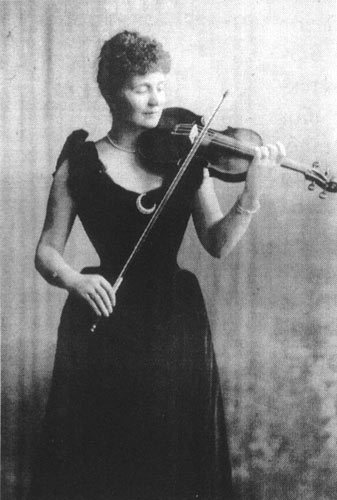
After Teresa Milanollo, the next name to stamp itself indelibly upon the public consciousness is that of “Norman-Neruda.” Other women-violinists, notwithstanding great talents and sensational successes, scarcely attained to the true immortality of fame. But the position of Neruda, in the hierarchy of musicians, is one that cannot easily be overthrown.
Wilhelmina Neruda, born in 1840 at Brünn in Moravia, began to play the violin almost as soon as she could walk, and appeared in public at Vienna in 1846. Her master was Jansa. At nine years old she played a concerto of de Beriot’s at the London Philharmonic Concert, and was enthusiastically received. In 1865 she married Ludwig Norman, a Swedish musician, and five years afterwards played again at the Philharmonic, and was induced by Vieuxtemps to remain in London until the winter, when she accepted the post of leader of the quartet at the Popular Concerts. From that time it has been the good fortune of Londoners to hear her every winter at St. James’s Hall. Of her perfect education, refined and intelligent phrasing, and depth of feeling, it is unnecessary to speak. The violin she uses is the “Strad” that belonged to Ernst; it was presented to her by the Duke of Saxe-Coburg and a few other distinguished amateurs.Upon the death of Ludwig Norman, Madame Neruda married Sir Charles Hallé, with whom she made a most successful tour in Australia. In 1895, as none of us have forgotten, Sir Charles Hallé died, and, upon the suggestion of the Princess of Wales (of whom “Neruda” has long been a personal as well as a musical favourite), a subscription was raised for his widow. In 1896 Lady Hallé was presented by many admirers with the title-deeds of an estate and villa in Italy, and a purse of £500. For so long now Lady Hallé has been a favourite of the British Public, for so long she has resided in our midst, that it is difficult to think of her as other than an Englishwoman. Yet neither her birth nor her parentage gives us the right to claim her as our own. But there is something in the repose and “at-homeness” of Lady Hallé’s bearing, both in public and private, and much in her devotion and loyalty to the British audiences who have delighted to applaud her through nearly half a century, that warrants the pride we all feel in our lion’s share of possession of her personality and talents. More than any other of the great violinists of the Victorian Era, she belongs to us. England may be proud of being the country of this great artist’s adoption. Her Majesty’s recognition of her husband, and the English title which, through him, “Norman-Neruda” bears, only serve to emphasize our claim to count her one of us.
italian
Dopo Teresa Milanollo, il prossimo nome che si imprime indelebilmente è quello della “Norman-Neruda”. Altre violiniste, nonostante talenti e successi clamorosi, rispetto a lei, a malapena hanno raggiunto la vera immortalità della fama e la posizione di Neruda, nella gerarchia dei musicisti è tale da non essere facilmente rovesciata. Wilhelmina Neruda, nata nel 1840 a Brünn in Moravia ( in realtà nel 1838 n.d.t) iniziò a suonare il violino prima di quanto non sia riuscita ad imparare a camminare, e apparve in pubblico a Vienna nel 1846. Il suo maestro fu Jansa. A nove anni suonò un concerto di De Beriot al London Philharmonic Concert accolta con entusiasmo. Nel 1865 ( n realtrà nel 1864) sposò Ludwig Norman, musicista svedese; cinque anni dopo suonò di nuovo alla Filarmonica e fu indotta da Vieuxtemps a rimanere a Londra fino all’inverno quando accettò l’incarico di leader del quartetto ai Popular Concerts. Da quel momento i londinesi sono stati fortunati da poterla sentire ogni inverno alla St. James’s Hall. Della perfetta educazione musicale, del fraseggio raffinato e intelligente e della profondità dei sentimenti, non è necessario parlare. Il violino che usa è lo “Strad” appartenuto a Ernst; le fu presentato dal duca di Sassonia-Coburgo e da alcuni altri illustri uomini amanti della musica e dilettanti dello strumento. Alla morte di Ludwig Norman, Madame Neruda sposò Sir Charles Hallè con il quale fece un tour di successo in Australia. Nel 1895, e nessuno di noi ha mai dimenticato, Sir Charles Hallé morì e, su suggerimento della Principessa del Galles (di cui la “Neruda” fu a lungo una delle sue amicizie personali preferite non solo musicale), fu raccolta una sottoscrizione per la sua vedova. Nel 1896 Lady Hallé ricevette in dono da molti ammiratori i titoli di proprietà di una tenuta e di una villa ( un palazzo) in Italia e un assegno di £ 500. Da così tanto tempo Lady Hallé è stata la favorita del pubblico britannico e per così tanto tempo ha risieduto in mezzo a noi che è difficile pensare a lei da una donna non inglese. Tuttavia né la sua nascita né i suoi genitori ci danno il diritto di rivendicarla come nostra. Ma c’è qualcosa nel modo di trascorrere il tempo libero di Lady Hallé, nel suo stare a “casa”, nel suo modo di fare, sia in pubblico che in privato, nella sua devozione e lealtà verso il pubblico britannico che ha amato applaudirla per quasi mezzo secolo, che giustifica il orgoglio che tutti noi proviamo facendo la parte del leone, nel possesso della sua personalità e dei suoi talenti. Più di ogni altro grande violinista dell’epoca vittoriana, lei ci appartiene. L’Inghilterra può essere orgogliosa di essere il paese di adozione di questa grande artista. Il riconoscimento che Sua Maestà ha elargito a suo marito e il titolo inglese che grazie a lui anche “Norman-Neruda” porta, enfatizza ancora di più la nostra pretesa di considerarla una di noi.
 Vera Mazzotta